25 June 2026

Up in frames

I seem to be spending an inordinate amount of time with picture frames. Yesterday was artwork drop-off day for the Didsbury Open, the second of its kind, and the second I've shown in. The exhibition is being hung this week to coincide with Didsbury Arts Festival getting underway on Saturday and this time round it takes place across multiple venues in the village: The Art of Tea, Smoak, Home café and Didsbury Library. 

So yesterday morning saw me busy printing and mounting and cleaning glass in order to get "Concrete Icons" ready for its close-up, and dusting down "Blue Magic 4" by David Gaffney to take along with it in the grasshopper-singing, searing heat. My Open piece last time round, "Rivers", was snapped up, so my fingers are crossed for "Concrete Icons", which I created in two sittings: one at the end of November, just before my op, and one in February, once my grey matter had started to thaw again after.

Visible/invisible is the theme for this year's Didsbury Arts Festival (running 27 June to 5 July), and "Concrete Icons" is a diptych comprising two concrete poems representing two iconic south Manchester buildings: the still visible Toast Rack, or Hollings Building, its letters creating a ‘beau présent’ anagrammatic poem, and the now invisible Owens Park Tower, with ‘Cosmos I’ mural by Didsbury artist Mitzi Cunliffe. (The pic is of Mitzi working in her studio, in the garage of her home on Cranmer Road, just up the way.)

Today and tomorrow, I'm prepping six smaller frames, to hold one of the "Drought Thoughts" poems I'll be premiering at my solo performance on Saturday. I spent yesterday afternoon – once I'd snuck back home sticking to the shade – reworking this number especially. So now it has a second life, even before it's aired, as a concrete poem, the form of which reflects the content, so it can be enjoyed both viewed and read, and will make a nice little addition to a wall, maybe your own? There will be six limited-edition framed prints available on Saturday – get your tickets to the event here.


02 June 2026

Drought Thoughts

I recently had my first proper rural trip away since my hip op, staying in the Yorkshire Dales for a week. I mention it because it inadvertently tied into what I've been working on recently, writing wise.   

An erstwhile sailor and hydrologist, I often write about watery subjects, but recently I’ve capsized that to explore “drought thoughts” as a poetry project – researching and writing while adjusting to life with severe arthritis. Drought was officially declared in the “Rainy City” of Manchester where I live the same week that my name went on the waiting list for a hip replacement, so it seemed appropriate to tie in this personal experience of creaking, crunching bones with the driest summer since 1976, when I was growing up on the Wirral Peninsula, a kind of island. That was last May (a year ago!) and I’ve since really enjoyed researching “drought thoughts” – from “dry-bathing” in the UK’s only desert at Dungeness before I ground to a halt completely, to charting the progress of Haweswater’s lost villages flooded to supply Manchester’s drinking water slowly resurfacing as the reservoir dropped. I’ve been thinking about daylighted rivers and winterbourne waterways, limestone and sandstone, the moon and tides, and the sun, responding to the recent “Helios” installation at Victoria Baths, where I was writer-in-residence, and the “Phoebus” print commissioned by Liberty for the Festival of Britain from the sculptor Mitzi Cunliffe, who lived and worked down the road from me. 

(Here's me with "Phoebus" on my actual first trip involving stopping elsewhere than my own house – at the amazing Women In Print exhibition at the William Morris Gallery in Walthamstow, and on until 21 June if you're in that neck of the woods; highly recommend.) 

Being Yorkshire born, of course the "Drought Thoughts" project led to me to giving a certain amount of time to dry stone walls, even getting in touch with the Dry Stone Wall Association (“lunky” was a particularly chewy word they proffered when I asked about terminology), so Yorkshire was top of my list for an escape t'country. I was rewarded with many delights including St George’s mushrooms and willow warblers warbling and bright yellow patches of cowslips and a robin singing from his spot atop an erratic and a wee hatched blue egg fallen from a hawthorn tree just coming into bloom and conversations with blackbirds and goldfinches and sightings of oystercatchers and buzzards and hearings of curlews and owls. I managed to go off road and my health app told me: “So far this year, you’re taking more steps a day than you did last year.” All good. I even managed to climb over a few dry stone walls, and I gave up on a few as well, but either way, it all fed an overall good disposition – as well as into some new poems. 

And how excited was I to go up a valley for other stuff (a craft brewery and an exhibition) and come back with a totally dry riverbed?!!!! The pebbles looked like potatoes scattered willy-nilly as if from a burst shopping bag, just dropped mid-flow as the waters of the River Skirfare disappeared underground, leaving a bright white scar, the likes of which I am all too familiar with. I'm so glad I shouted over to a farmer, despite a sign at his gate that clearly stated “No Idiots”. He told me it's because of a fault and that if there’s a sudden and sustained substantial rainfall, the river returns, bombing it down the dry channel like a tidal wave, or a bore. Quite the sight, he told me. I don’t think he thought I was an idiot as I excitedly explained my presence peering over his dry stone wall and apologising for interrupting while he fed the chucks. Then again, maybe he’s since replaced the sign at the gate with one that reads “No Poets”.

Anyway, "more water for the Wharfe, more words for the poets" as someone (me) once said, and I've just finished another poem, about this karstian wonder. It's another new poem for the upcoming performance slot I've secured at Didsbury Arts Festival later this month to premiere some of the new poems. I'm really looking forward to sharing some of the new work, and if you enjoyed my special DAF commission “Flight Patterns”, which fed into my most recent Wainwright Prize-nominated book “Wanderland”, or indeed if you liked my concrete poetry shown at last year’s inaugural Didsbury Open, then “Drought Thoughts” may well be up your street! Join me as I transform landscapes into soundscapes on Saturday 27 June, 5pm, Emmanuel Parish Centre (Upper Hall). Tickets on sale now here. (Thanks to James for the fabulous flyer!)

20 February 2026

Constantin's Colonne and concrete constructs

Yesterday marked 150 years since Constantin Brancusi was born in a Romanian backwater; looking at Glearth, the same kind of ribbon settlement in which I was pulled over for speeding en route to a wedding in Transylvania. This was the final leg of a very-long-and-not-without-its-adventures drive from south Manchester to Sibiu, without a proper map. As you do.

Anyway, I'm a big fan of Brancusi's work and should the Centre Pompidou reinstate his studio reconstruction upon reopening (scheduled 2030), I can highly recommend a visit. I was so taken with my first and subsequent trips that I often take it upon myself to create concrete poems in the shapes of his sculptures. Here's 'Colonne Sans Fin', from my pamphlet Using Language, which just came up as a FB memory – three years ago, lovely Invisible Hand Press editor James and I were finalising cover designs, garnering quotes and proofreading.


I've modelled 'Colonne Sans Fin' next to a photo in my Brancusi book of one of the Endless Columns in situ at the 8 Impasse Ronsin studio in Montparnasse (long gone, and replaced by a morgue; I've checked). Legend has it Brancusi twisted the arms of mates including Man Ray to help him lug a tree trunk back to Paris from the countryside so he could turn it into one of the columns – the next two slides show a column in the garden of a rich patron and some of the columns in the Pompidou show a couple of years back. That was a hot day – there's a selfie on my camera roll and I look like I've melted.

Anyway, bon anniversaire, Constantin, la multi ani! By coincidence, I've been working on some more concrete poems and sculpture-inspired pieces this week. The stars must've aligned.


11 January 2026

Decades, dates, David Bowie and me

There's been a lot of coverage to commemorate ten years (yesterday, 10 January) since the death of David Bowie, and the concurrent release of his final LP Blackstar (on 8 January, his 69th birthday). And rightly so: it's a great album; he was a talented multifaceted artist. I'll admit, it took me a while to accept him into my early listening life after taking strongly against much of his 80s output (let's not talk about collabs such as Under Pressure or Dancing In The Street), but luckily that was eventually rectified and I'm as big a fan as any of Space Oddity and Life On Mars and even songs unrelated to any celestial set-ups. 

But I don't usually blether on here about such things as who and who I don't lean towards musically – and there's a reason why I'm doing it now: in order to open up a tiny crack and shed a little light into my world beyond reading and writing. Four weeks ago tomorrow, I had my right hip removed and replaced with a foreign body that it is claimed will make my life better. In the month since the hip op hippety op don't stop the boogie, I'll not lie, my life has been a very long way from better. Who knew pain like this could exist, and also how many types of pain there are? 

We won't dwell on this, nor on the absolute inconvenience of not being able to do the most mundane things like putting on socks, nor the realisation that dropping things on the floor is actually more commonplace than house sparrows or terrible second series you've waited so long for, in vain, the unforeseen inability to take in any written words beyond a couple of teeny Insta posts and one easyread article in Vogue (about Chanel here across the Channel; they assumed the punning half-rhyme was enough to hook a feature on), the downright discombobulation at the concreteness of two steps forward and one step back. (Pic is of me on one of my last trips out before the procedure, a sunny winter's day on Castlefield Viaduct.)

Anyway, the op was a week before my birthday, which is two days before Christmas, so at least I'd stocked up on nice biscuits and booze-tinged truffles from the Aldi middle aisle before checking into the hozzy (Trafford General, birthplace of the fabulous NHS). Small wins. Since you ask, I turned 54, like the famous New-Yorkaise studio where David Bowie was a regular. Ah, yes, so the Bowie thing. Well, ten years ago, on Saturday 9 January 2016, I was in a cab with Blackstar playing over the tinny speakers and the driver pretending not to be in panic mode as he drove an inflating me a short distance to Manchester Royal Infirmary where I was superspeedtriaged and rushed through to A&E and pumped full of antihistamines and steroids and dragged back from the edge of anaphylaxis and all the rest of it. 

Exciting stuff, but what has this to do with total hip replacements? OK, just before the festive season of 2015, I'd been shown the results of an X-ray, having presented at my GP – not for the first time – with shocking pain in my right hip. As with the previous presenting occasions (one of which was during a period involving me having to make my way up and down the stairs of my house in Chorlton – so we're going back a long time here – on my bum), the X-ray showed significant-but-not-significant-enough erosion of my old bones thanks to arthritis (thanks, Arthritis). The doctor was very sympathetic and advised ibuprofen as ideal for next time I found myself in discomfort or anticipating being on my feet all day or undertaking other such physical jerks. The morning of Saturday 9 January 2016, David and I were sitting in our flat's kitchen, planning a trip out to recce possible places for moving to while eating breakfast (boiled eggs and soldiers, orange juice and coffee, since you ask – plus, of course, the magical antiflammatory I'd been advised). 

Five minutes or so later, I was saying I didn't feel so good and was having a little lie-down, with Pushkin Cat lying on top of me purring while David Googled "anaphylactic shock". It was Leap Year. On 29 February 2016, I asked David to marry me; this one's a keeper, I thought. Later that year, we moved, on Brexit vote day. We'll have been here ten years this summer. We tied the knot up the road from here on Saturday 29 February 2020 and had our honeymoon in a springtime Paris, making it out on the final Eurostar before France went into confinement, and the UK announced lockdown effective 26 March. There's always a date-related story, isn't there?

21 September 2025

Concrete poetry at the Parsonage

When I submitted my artwork to the Didsbury Arts Festival Summer Open earlier this year, I knew I was taking a punt, as it’s not what you’d call usual exhibition fare. I love to create concrete poetry, which plays with text and also how it appears. Often a concrete poem can take the shape of its subject matter; sometimes its layout can reflect a mood or feeling – in the case of my submission, “Rivers”, the whole look is intended to convey a sense of movement.

“Rivers” consists of three concrete poems: the simple ‘Boat’, which took its original spark from Lisa Robertson’s book of that name and a reading she gave on a typically Mancunian autumnal evening in Ancoats; ‘Banks’, inspired by me navigating the River Seine through Paris a number of years ago, and ‘Arethusa’, a nod to the opening of Under Milk Wood. 


An earlier version of ‘Arethusa’ appears in my limited-edition poetry pamphlet Lune, which was published by Red Ceilings Press and is now sold out – it notes the names of all the craft moored on the creek downstream from Dylan Thomas’s boathouse in Laugharne when I wandered along there a couple of years ago. 


The three pieces were made at different times, but with their watery themes, I felt they sat well alongside each other so I brought them together and played about with their positioning to also achieve an appealing picture.


I’ve mentioned the idea of “playing” twice now – and playing about with words and ideas and techniques is something I enjoy when approaching all my poetry, not just the concrete work. 


I’m a big fan of the Oulipo movement, a group of writers and mathematicians who got together in 1960s Paris and applied constraints such as anagrams and noun-swapping and forms such as sestinas and snowballs to free their work. I learnt about Oulipo (Ouvroir de Littérature Potentielle or Workshop of Potential Literature) as an undergrad at the University of Manchester during the 1990s, taking French Studies and eventually submitting a thesis on the Oulipian writer (and crossword puzzle setter) Georges Perec. 


When I returned to do a masters in Creative Writing in more recent years, I also revisited my studies into Oulipo and started applying restrictions to my own poetry as I developed my style. I really like how imposing certain systems forces me to land on words and phrases I may have otherwise overlooked, and which by default makes the poem infinitely more interesting and innovative than it might otherwise have been. It’s also pretty good fun.


Concrete poetry also helps focus the mind and I appreciate being able to make something that is a poem but also something that can be put in a frame and hung on the wall. I’ve shown concrete poetry in the past, in the Manchester Open at HOME and also at the annual Blah Open in Withington, and submitting to the DAF Summer Open paid off as the whole show was really impressive with some fabulous work including by well-known artists, and superbly curated by Nan Collantine, setting “Rivers” beside Chris Williams’s lovely lighthouse linocut in the Orange Gallery at Didbsury Parsonage (coincidentally where I performed my “Flight Patterns” commission for DAF 2023, pictured). What’s more, “Rivers” now has a new home, hurrah!


The DAF Summer Open PV was on Friday 4 July 2025 and the show ran at Didsbury Parsonage, Manchester, until Sunday 20 July 2025. Didsbury Arts Festival will be back with a full programme in the summer of 2026.


READ MY BLOG POST ON THE DIDSBURY ARTS FESTIVAL WEBSITE HERE.

11 August 2025

The windmills of my mind

It's a little over a month since the European Poetry Festival rolled into town (well, the town of Liverpool). My collaborator – the marvellous Carolyn Hashimoto – was delayed en route from Scotland, wasps and wrong turns, but well in time for the intros, by Chris McCabe, in his LiPS (Liverpool Poetry Space) capacity, and EPF organiser extraordinaire SJ Fowler. The annual European Poetry Festival pairs up poets who have often never met, and many of whom cross borders to join the project, to produce brand-new work (to fit a seven-minute timeframe) to be performed at different events around the UK.

At the Liverpool leg, Carolyn and I were up third, mesmerising (I'm sure) the Open Eye Gallery crowd with what Carolyn named "the chant section", before launching into our piece properly. The chant section involved us wandering around in not quite dizzying circles and wittering what probably seemed to be random words and numbers. O ye of little faith, there's no randomness at EPF – there's always method to the madness! 

And much method was applied to mine and Carolyn's particular creation – a sestina inspired by spirals and vortices and maelstroms and eddies and whirlpools and whirlwinds. Carolyn landed on the theme, combining her current concerns with my own, emailing: "I’ve been writing around Nothingness and Vortex most recently. Spinning in circles and not getting very far, but I did wonder if there might be some way of connecting the work you are doing with rivers and seas with whirlpools and maelstroms...?" 

Next, I landed on the form, after lugging my well-thumbed copy of not insignificant-in-size The Penguin Book of Oulipo on a trip to London, where I happened to be seeing its editor Philip Terry, at the issue launch of Long Poem Magazine at the Barbican. As I dug into The Penny Borough of Ourselves (its alternative N+7 title), it dawned on me that the sestina would link nicely to our spirals and going round in a circle. The slightly elongated train journey from Manchester, meanwhile, meant I could go rabbitholing – a mention of “gidouille” led me to finding out this denotes the 11th month in the Pataphysical calendar, corresponding to the period June 15 to July 13 – the performance was chalked up for July 6 and I was soon going to be passing the Collège de Pataphysique on Boulevard Diderot in Paris. It all had a warm feeling of circular serendipity.

So, here's the science: a sestina incorporates six stanzas each six lines long, moving along following a pre-set pattern of end-words, culminating in a final stanza of three lines involving all six end-words, two per line. Phew. It’s super complicated, the old sestina, but as a collaborative effort, I thought it might work quite nicely. For the record, the pattern of the end-words, in stanza order, is: 123456 / 615243 / 364125 / 532614 / 451362 / 246531. The sixth stanza is then followed by a tercet that is known variably by the French term "envoi", the Occitan term "tornada", or, with reference to its size in relation to the preceding stanzas, a "half-stanza". It consists of three lines that should take the pattern of 2–5, 4–3, 6–1; the first end-word of each pair can occur anywhere in the line, while the second must end the line.

We decided that the best way forward would be to pick our six end-words between us, thinking about incorporating things to do with our thoughts of whirlpool, vortex, sea, tide, sun, moon and wotnot, and coming up with a longer list then whittling that down… After a bit of backwards and forwards, this became Flow / Pull / Swirl / City / Side / Blue – and this selection later on became the basis of the chant sections, which closed as well as opened our performance. The chant sections (pictured below) saw me recite? incant? the end-words in the order they appear in the sestina, while Carolyn came up with "a little bingo sheet", or "pull side / poolside bingo" of the numbers and words. Someone said they "got it", so that's good.

Our next job was embarking on the first stanza, which we both made a stab at, then I – by now on holiday in Provence, where the sestina was invented by a troubadour called Arnaut Daniel (who appears in Dante's Inferno) – fiddled about with the two resulting versions, so that one of the first stanzas could become the second. Each had its own feel, but the two teamed up nicely – Carolyn's with time zones and a sense of distance and proximity and "two minds", and mine tying in with that via the aforementioned Pataphysical calendar and foreign names and watery journeys... we both liked my stanza to open and Carolyn's redone as stanza 2, as it meant we started abroad and then came together in Liverpool, with the first beginning "Round and round" so we're spiralling from the get-go, and tying in with the performance movement ideas we were having, and the second stanza starting with "Always in two minds"... So our pattern was set and we continued building the poem like a tennis match.

Having slipped into the River Seine in the first stanza, in the third, I continued travelling via waterways and thinking about whirlpools, and brought us into the Irish Sea, with Liverpool in our sights, passing Anglesey's Menai Straits Swellies and the Hilbre archipelago, tidal islands just off the Wirral peninsula, where I grew up. More rabbithole research (my favourite kind) led me to discover the full moon in July is known as a buck moon and it reminded me about the legendary deer that swam from Wales to Hilbre (where my uncle John was a pioneer of the bird observatory).

By stanza five, I'd remembered that the wee boat I sailed out of Liverpool and around the Irish Sea (and beyond) was a Twister, and, as Liverpool is often a bit on the blowy side, my thoughts turned to all things windy. The "tornada" of the sestina means turned or twisted, and the usual French word for whirlwind is "tourbillon", one of the words I'd already written in my notebook – they were fixing the windmill sitting at the top of the village where I was staying, so windmills had been on my mind (never ending or beginning on an ever-spinning reel). 


Also in search of inspiration in keeping with our project, Carolyn took herself off to the Crawick Multiverse in her home county of Dumfries and Galloway – a large land art project with distinctive snailing hills designed by Charles Jencks (see also The Garden Of Cosmic Speculation, Jupiter Artland and the art gallery in Edinburgh), and offering forth some immense physicality in the "upward swirl" as we are invited by Carolyn to "climb the spiral hillside".

Carolyn also tabled some brilliant plans (and even diagrams!) for the performance, talking Slinkys, Maypoles, Swingball, but my inability to turn quickly meant these had to be sidelined. We thought about having the person not speaking walking around the person speaking, reflecting the vortex and spiral idea, with maybe one of us going clockwise and the other going anticlockwise, then that might also represent time zones and calendars... but then we remembered the microphones. Those wires could have wreaked havoc. Anyway, you can see a film of what we did get up to here

The other performances can also be watched on YouTube, and the poets involved were, in this order: Lenni Sanders and David Spittle; Julia Rose Lewis and Alec Newman; Carolyn Hashimoto and Sarah-Clare Conlon; Tom Jenks and SJ Fowler; Endre Ruset and Stephen Sunderland; Sarah Dawson and Andrew Taylor; Chris McCabe reading for Thomas Ballhausen and Robert Sheppard, and, finally, Lena Chilari and Michael Sutton. More on the European Poetry Festival here and specifically the Liverpool leg, which closed EPF 2025, here.


(Apologies for the all-over-the-shop fonts – Blogger is ancient and creaking and I looked in the back end to organise the code and came straight back out again, it's so hideous in there.)

15 July 2025

Photographic memory

Last weekend, I was back at Liverpool's Open Eye Gallery for the eleventh, and final, instalment of this year's European Poetry Festival. More on that in a future post, however, as I have other thoughts to share right now. 

My visit to the Mann Island photography outpost in 2024 sparked me to write a piece to enter into a fancy art magazine competition. This pageant's details had been wafted under my nose by Roma Havers, who had been facilitating the Critics Collective, a Manchester Poetry Library initiative for which I was lucky enough to have been selected to join the ranks. Our six-week session series – which featured presentations and workshops led by guests including Khairani Barokka, Kit Fan and John McAuliffe – culminated in participants writing and placing (or attempting to place) reviews.

I have some incoming in PN Review (my second appearance sporting my jaunty new critic's hat) and The North. I've seen the proofs for both, so I guess they're imminent. I do not, on the other hand, have anything in the fancy art magazine. Unperturbed, I tinkered with the piece slightly and submitted it to another fancy prize, and that got me nowhere either. 

Hey-ho. It felt a shame, as the exhibition I'd reviewed was fab, but as it was taken down in September, I thought it best to forget about it. 

Then, as I say, last weekend, I was back at Liverpool's Open Eye Gallery, and I noticed that the photographer whose show it was, Stephanie Wynne, is involved in another project, and you have until 24 July to catch it at Crosby Library. Not All Who Wander Are Lost, part of the Photo Here programme, sees Stephanie as artist in residence collaborate with members of Crosby Camera Club to explore the "feel" of Sefton by combining photography with psychogeography. Wandering and pondering, what's not to like? Check that out here.

So here's the review I wrote of Stephanie Wynne's The Erosion. Better later than never...

Stephanie Wynne's The Erosion, Open Eye Gallery.
Install photo: Rob Battersby June 2024

Littorally Speaking by Sarah-Clare Conlon

The naturally eroding sands of Crosby Beach are gradually revealing a hidden human history, as documented by Liverpool-based photographer Stephanie Wynne in an exhibition commissioned by Open Eye Gallery


It almost wasn’t meant to be. Arriving with minutes to spare, I whipped out the two pairs of binoculars I’d lugged via tram, taxi, train and tube, located my collaborator, handed her one, then grabbed a seat in the audience and took a breath. It was instantly cut short as I gasped at the photographs to my left.


Here were five evenly sized, evenly spaced studies, each setting wave-worked orange bricks and hand-carved blocks of white marble against a bright blue letterbox of sky. These were broken homes and collapsed cornershopfronts, factory facades and grandiose gravestones. These were smithereens of Liverpool after Second World War air raids. 


Creatively exploring Crosby Beach climbed into my must-dos in 2020 when I heard about its secrets gradually being revealed by time and tide, simultaneously learning that family had grown up within spitting distance, on the sandblasted terraced streets of Waterloo. But we were in lockdown and the coast seemed a long way from Manchester.


Stephanie Wynne, however, is local and has photographed the beach for years, she tells me when I get in touch. I’d outlined my encounter with The Erosion; that I was one of 14 European Poetry Festival performers reading in pairs at Liverpool’s Open Eye Gallery, that I was taken by our backdrop. I ask about the five warm-hued shots with light surrounds, a contrast to the strand’s dark story.


“The day images were taken on different days in different seasons,” Wynne tells me. “Most photography projects that have value are long term – you need to photograph and re-photograph. You need knowledge of a place to be able to represent it.”


On the opposite wall, beyond which the River Mersey flows out to the Irish Sea, eight black-mounted views elicit an ethereal, other-worldliness, and a sense of nature taking things back – spume-slippery seaweed slicking over once-windowsills, creeping gale-thrashed marram grass grasping footholds in crumbling mortar. “It is a poignant landscape,” notes the exhibition blurb. “Man-made but sculpted by nature.”


Wynne elaborates: “The night pictures were the first in the project, taken between 1 and 8 May 2021, to mirror the week of nightly bombing in May 1941 – the May Blitz. They are all long exposures with torchlight – referencing searchlights – exposing the foreground details.”


Eighty years before Wynne took her camera to the beach, the Luftwaffe pounded Liverpool. Nearly one-third of houses were damaged or destroyed, thousands of buildings in the strategically vital port city flattened. The resulting rubble was dumped on a mile-long stretch of shoreline, part coastal defence, part collective memory wipe. 


Wynne researched war waste on Merseyside and beyond during a six-month residency with Open Eye in spring 2023, and, to give context to The Erosion, picked four black-and-white archive images from Sefton Library Service and Imperial War Museum, which oversee the exhibition. 


At the far end of the room, I find myself drawn to two larger, unframed prints, very much focused brinewards. Watery themes run through my poetry (I used to keep a little yacht upstream at Brunswick Dock), and, to me, these feel different to the other groupings and their land-based gaze. It turns out they are part of a new series of pictures, explains Wynne: “To further the project since January I decided to look at how the water and intertidal life is affected by our interventions.”


This pairing – one calm, half-submerged; one rippled, kinetic, as if the swash is rushing in – was chosen by curator Max Gorbatskyi. “He felt two was enough to tell the story,” says Wynne, continuing: “Max wanted to create a narrative throughout the exhibition – the daylight wall shows the archaeological details, shifting bricks, plantlife, how people use the beach and construct playful ‘artworks’ – and I decided to create one of these makeshift sculptures.”


Spying this 3-D pile of debris – cobbled masonry necklace-linked with a ribbon of rusting steel reinforcement rod – was another highlight at our event, one of the poets hiding behind it, then reappearing. My poetry partner and I delivered our ebbing and flowing piece about the ocean, squinted through our binoculars, The Erosion around us also providing a long view through its close-ups.


Stephanie Wynne’s The Erosion was part of LOOK Photo Biennial 2024: Beyond Sight, 28 June-1 September 2024, at Open Eye Gallery, Liverpool. 

07 May 2025

Wandering and pondering

A couple of weeks back, on Thursday 24 April, I launched my latest poetry pamphlet, Wanderland, a Poetry Book Society Summer 2025 Listing and nominated for the prestigious Wainwright Prize. We celebrated with a wonderful evening of readings, including kinepoetics from Scott Thurston and poems about concrete (but not concrete poems) by Lydia Unsworth, who even agreed to revisit the Oulipian collaboration we made for European Poetry Festival a bit back.

So Wanderland is out with Red Ceilings Press (the same publisher as Lune), as they make lovely little A6 numbers, perfect for popping in your pocket and taking for a wander and a ponder, which is what Wanderland was inspired by and what it aims to inspire in its readers. Wanderland brings together three sequences about wandering and pondering. It lifts off with ‘Flight Patterns’, inspired by the RSPB’s Manchester origins and a pioneering ornithologist uncle, tours the watery world of Ilkley’s moorland spas and springs (from my Ilkley Literature Festival residency), and ends up visiting various urban-rural edgelands via a series of 100-word prose poems, which appeared last spring in the special Urban/Rural edition of Spelt Magazine.

Anyway, the Red Ceilings online store has already sold out of their copies of Wanderland, but I ordered extra, so numbered and signed limited editions are still available direct from me. Indeed, this weekend, I'll be reading from the book at this year’s Weaver Words Literature Festival in Frodsham, where I went to high school, so you can snag a copy then; I'll bring my best pens. 

I'm going to perform the sequence of poems from the collection called ‘Flight Patterns’, featuring endangered British birds, written in tribute to Emily Williamson, who, 135 years ago, launched her Wear No Feathers campaign and subsequently set up the forerunner to the RSPB near to where I now live in South Manchester. I was commissioned to write ‘Flight Patterns’ for Didsbury Arts Festival and premiered the 12 poems (one for each month of the year, and for each of the 11 newly red-listed birds at that time, plus one for "all the birds") to a packed room at the Old Parsonage on a sweltering day in the summer of 2023. The performance, complete with birdsong and church bells and Ladybird books and poetry map and a bit of background on the process of making it, went down really well and received lots of lovely comments. I'm not yet quite sure how I'm going to squish it into half an hour, but I'm sure it'll work out fine.

So a bit more about the book. Wanderland is a meditation on getting lost in nature without venturing too far from the North of England’s urban sprawl. From the feathered friends of Manchester to the watery world of Ilkley’s moorland spas and springs, these poems urge you to take a moment to breathe. Welcome to the Wanderland journey – two poetry maps reconnect you with the hidden wonders sharing our towns and cities; a third sequence is for wherever you find yourself in the edgelands. Pop the book in your pocket and discover the paths yourself or escape from that bus commute with a virtual wander in the great outdoors.

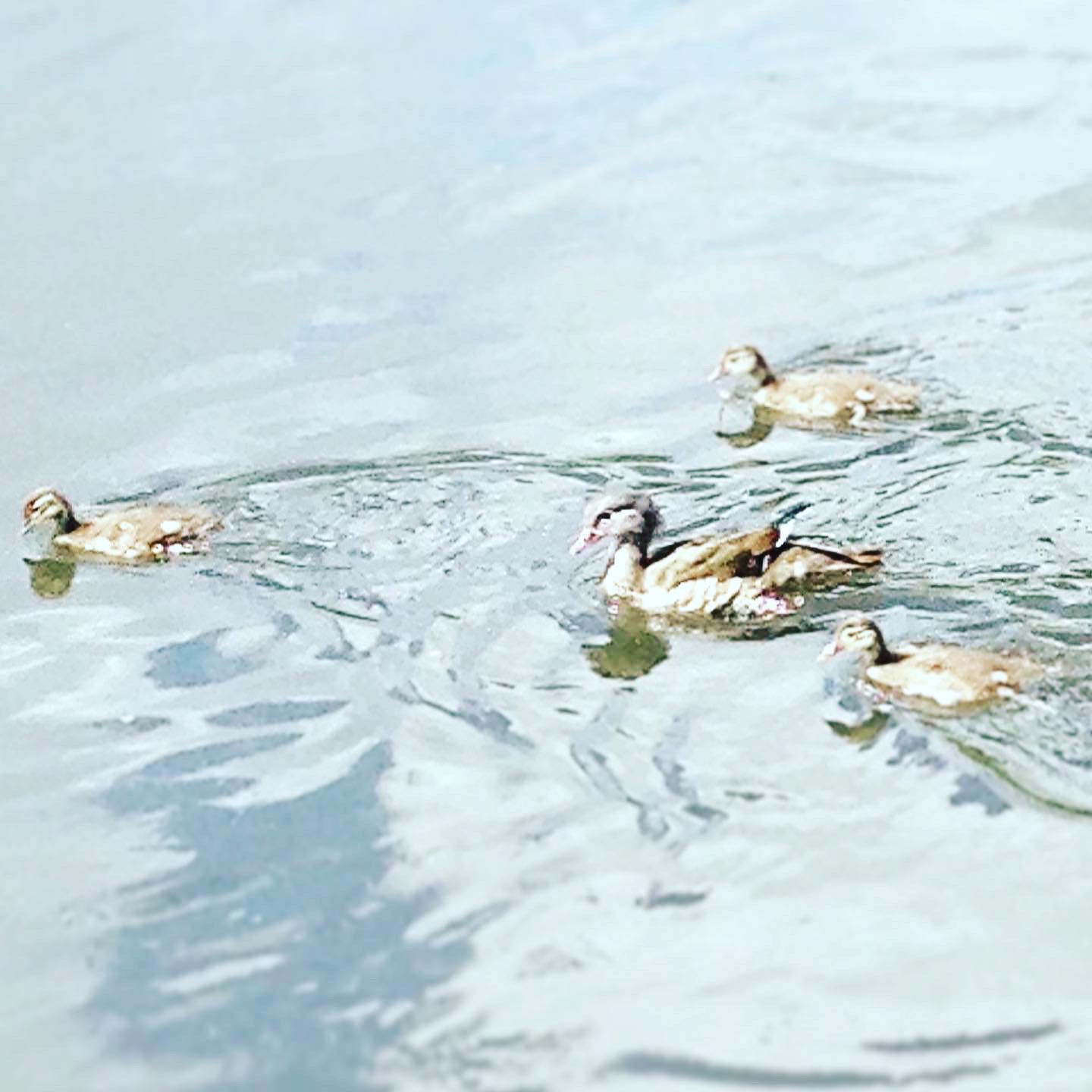
I said on the Red Ceilings mailout: “I’m inspired by nature and the North, and fascinated by place and language. I’d like everyone to feel welcome on the Wanderland journey – follow in my footsteps and read the pieces in situ or join me for a virtual wander, getting lost in the great outdoors from the comfort of your own armchair.” Here are some rare ducks I spotted on the River Mersey down the road.


Wanderland has had a fabulous reception, with me offering lots of little sneak peeks into it at different readings, trying to keep it so noone has to hear the same thing twice. Last night, we were in Prestwich, at Crooked Poets, where there were, happily, some paintings of birds hanging just to the right-hand side of the microphone as I wittered on to the audience. 

Will Mackie, in New Writing North’s New and Recent Poetry from the North: Spring 2025 round-up, said: “Sarah-Clare Conlon’s Wanderland is full of gorgeous observational poems about nature that are lovely to read and greatly skilled. Poems like ‘Colour by Numbers’ and ‘Thoughts on Silence’ have beautiful, memorable lines that conjure precise visual images.”

I garnered a cover blurb from Rachel Bower: "This is an intricate collection of wonder and maps and journeys. Some of the poems carry us through the year; others guide us through rivers and woods; streets and skies; birds and storms. The series of poems anchored by the specific site of Ilkley Moor brings the landscape vividly to life. Beautiful poems of treasure and nature and light." 

And another from Jennifer Lee Tsai: "In Wanderland, Sarah-Clare Conlon takes us on an odyssey through nature and the edgelands of the North West. In these lyrical poems, we encounter ‘heartening aerial sights’, ‘sikes and sandbanks, marshes and margins’. There’s a sense of playfulness in these sequences of sudden reveries as Conlon invites us to ‘close your eyes and listen’, to see ‘starshine/in the gutter’. Her arresting use of language exhorts us to ‘imprint a pattern’ and ‘create our own ripple effect’. This is a gorgeous pamphlet – stylishly crafted, attentive and attuned to the surprises of the world around us, mindful of our place within it."

And as for the cover itself, the watercolour is by Susan Platt, who called it Poetic Nuthatch. The nuthatch is the second bird to feature in the book, "all disco eyeliner". Sue studied Fine Art at Manchester Polytechnic in the 1980s and has worked extensively within gallery education, lecturing in Graphic Design at Manchester Metropolitan University for over 20 years. I'd been following Sue's Instagram account intently during lockdown as she painted and posted bird upon bird, so I knew she was the person for the job. She's a mad keen birdwatcher and recently exhibited in “Fledge - A Year of Birds” at Contemporary Six gallery in Manchester. Be sure to go and see when she next has a show! 

And check out my "Live" section for my own upcoming readings. (And apologies for the state of these fonts. Even with my ability to code, now ageing Blogger is full of glitchiness.)

18 March 2025

A record of records

To celebrate Record Store Day 2025 (Saturday 12 April), writers and musicians have teamed up to pen ten tracks for Sleeve Notes, a unique collaborative project and live performance. I'm one of the writers.


The artists have responded to how records have shaped their lives and thinking, each creating a brand-new track combining spoken word and music. The pieces will be available as a limited-edition cassette and premiered live by the writers and musicians at Manchester’s International Anthony Burgess Foundation on the evening of Record Store Day (doors 6.30pm, £5; tickets here) – giving you plenty of time to head shopwards beforehand to get that all-important vinyl. You can also hear a preview of the album via Bandcamp here.


The project has been featured on BBC Radio 6 Music by both Guy Garvey and Marc Riley, and there's a write-up, including the full line-up of writers and musicians involved, on Creative Tourist here. I was asked to write a bit for Joyzine about the inspiration and process behind my contribution, "Breathe Silence", with artist and musician Jez Dolan. Obviously, I wrote probably way too much and it's unlikely to all get published*, so here you go...


Sarah-Clare Conlon x Jez Dolan “Breathe Silence”
When I was asked to be one of the contributing writers to Sleeve Notes, I began by nailing down a narrative, which led me to think about the ritual of selecting and playing records, especially in the context of growing up and going round to friends’ houses to listen to music. 
My jumping-off point then was messing about with the sounds of words – my aim is to imbue my poetry with an aural quality, for example through assonance and alliteration, percussion and sibilance, to create an evocative soundscape. I’ve been performing regularly since 2010, and I love creating work that will have impact on both page and stage. 
I invited artist and musician Jez Dolan to work with me, as I thought his double bass would provide the perfect backdrop to my words, and, after an initial chat about influences and ideas, I spent an evening riffling through my vinyl collection, picking out artists I listened to as a teenager – Talking Heads, OMD, Prince, Kate Bush – and making notes on the noises of putting on a record, not just the songs themselves. I have a Pro-Ject deck and it doesn’t have an automatic arm lift, so the stylus just goes round and round at the end of a side, and it turned out each LP had a different kind of rhythmic quality. 
I sent Jez a draft of the text – which I’d approached slightly as a song, with I suppose verses and a chorus, and a refrainy thing – and a quick recording so he could get an idea of how I sounded reading the words. Jez then spent a bit of time with the words coming up with some options, including a riff and some drone, and the next step was me meeting Helga (the double bass) and spending an afternoon playing around and nailing down a firmer direction for Jez to go down and develop. One thing we agreed was that my words needed to be edited down, while Jez wanted to create an extra musical element, so at our next get-together we had a more streamlined version of the written piece and a more sophisticated composition. We practised this and once happy with the end result – called “Breathe Silence” – we recorded it, then drank some wine to celebrate.


Update: *indeed (also I note I did more than one "nailing down" in the original) – you can read the Joyzine article here. It says mine and Jez's track has a "beat-generation, jazz-vibe". Niiiiice.


07 February 2025

Tootally Wired lives on

Thrilled to have ‘Repetitions and Pauses’, originally dreamed up for the Tootally Wired project in September (thanks to Nic Chapman for the photographic evidence of part of the creative process as well as the performance event, which I also compèred), accepted for publication by Long Poem Magazine.

Issue 33 is due out in May. I was asked to send the editors an introduction to the writing process of the poem, which I think is a great idea! Sometimes I spend ages doing research and working out how to approach the actual piece – what it should look like, what it should sound like, what will stand it apart from the other pieces being written for a project – and that whole teeth-pulling procrastination part is often lost in time, like tears in rain...

‘Repetitions and Pauses’ was conceived for a commissioned performance project as part of Manchester Histories Festival. Six writers and a sound artist were each invited to respond to the Tootal scarf, a Manchester export, premiering their pieces live in September 2024 at Manchester’s Central Library for a sold-out event called Tootally Wired. I enjoy working within constraints and my approach to writing the piece was to consider the construction of the garment, and how this might be applied to my own creation. Traditionally Tootal scarves are woven and repeat printed silk with hand-applied tassels, and I wanted to incorporate this into the fabric of the poem – the ‘choruses’ not only evoke the process and the product, but also the musicality of the looms and machinery used in the manufacture, and the rhythmic back and forth of the supply and distribution network involved. As a former journalist on fashion glossies, I was interested in exploring both the history of the brand and the craftsmanship involved, so I spent some time at Edinburgh’s world-renowned tapestry studio Dovecot and with a textile artist at Manchester’s Rogue Studios, who explained the intricacies of passementerie and other weaving practices. As they require a hands-on, human skill, and with silk a natural product, I was also compelled to consider the industry’s impact on, or implication in, the landscape, where, even in the most urbanised and polluted of settings, nature manages to creep into the cracks. This in turn had me thinking, and writing, in a circle.

The Tootally Wired writers were, in performance order, Emily Oldfield, Tom Jenks, Wendy Allen, David Gaffney, me and Nicholas Royle, with a musical interlude from sound artist Gary Fisher. We had a Tootally Wired ident created by Zoe McLean, Tootal-related footage from the North West Film Archive, and mannequins sporting Tootal scarves. It was funded by Arts Council England.


18 November 2024

Blah! Blah!! Blah!!!

Two of our favourite hangouts have closed their doors in recent weeks: one due to the decision to discontinue trading at one of their two sites (so at least they're not gone forever); the other after their estate agent landlords turfed them out unfairly (and likely unlawfully). This latter, Café Blah, were evicted with no warning (and right after paying their rent), and, following a sit-in protest and a take-to-the-streets demonstration, a Just Giving campaign is ongoing to help them get set up in a new space as soon as possible. 

A vital part of Manchester’s creative community, the folks at Café Blah regularly put on bands and DJs and sound artists and films and spoken word and art shows and all sorts of fabulous necessary cultural activity – scant days before their locks were unjustly changed, Blah co-hosted the third Party For The People and a literary quiz for the first-ever Withington Book Festival. While making our way to the demo just a week on from making our way to read at WBF, David and I decided to try and make sure Café Blah can host many more great events!

As a flurry of gigs were organised by bands at the likes of Peer Hat and Withy Public Hall, we've been busy behind the scenes setting up our own #SaveCaféBlah Fundraiser, a reading event bringing together loads of fantastic writers serving up wonderful words to contribute to the #SaveCaféBlah campaign. 

Blah! Blah!! Blah!!! Writers For Café Blah – poetry and prose for the people – will take place on Saturday 23 November, 5-7pm, upstairs at Withington Public Hall Institute, at the village end of Burton Road, between The Orion and Sainsbury's. Tickets are £10 and are on sale now – you need a ticket to get in, but if you can’t make the event and want to donate please use the Save Café Blah Just Giving link (see below for all the links).

LINE-UP: The Blah! Blah!! Blah!!! #SaveCafeBlah wordy fundraiser readers will include purveyor of fine flash fiction David Gaffney, reading from his pamphlet Whale, and Professor of Poetry at the Centre for New Writing John McAuliffe, reading from his latest collection National Gallery. The Blah! Blah!! Blah!!! line-up will also include Joey Francis and Tim Allen of Peter Barlow's Cigarette, Steven Waling and Pam Galloway oft spotted at Manchester Poets, and Anna Percy of the newly reinvigorated Beatification. We’ll also be hearing from Broken Sleep Books poet Nóra Blascsók, Confingo storyist Nathan Bailey, Dry River author Alicia Rouverol and death of workers/Red Ceilings/many other published writer Lydia Unsworth. Joining the party are The Emma Press-pamphleted Lenni Sanders, of Manchester Critics Collective, Red Ceilings Press-pamphleted Steve Smythe, of Speakeasy, Guillemot Press-pamphleted Jazmine Linklater, of No Matter, and Sublunary Editions-pamphleted Tom Jenks, of zimZalla and formerly The Other Room. I will be compèring and might read something too.


Bagsy your ticket quick, it’s less than a week away!


* Tickets are £10pp. Eventbrite will add a fee to each ticket price. Here's the ticket link.

** All proceeds go to the Save Café Blah fund. Big thanks to the artists for giving up their time and super big thanks to the Withington Public Hall Institute peeps for their support in the effort to raise funds for Café Blah, letting us have the venue for free.

*** Please note, if you'd like to contribute to the Save Café Blah fund, but can't make this event (or you'd like to contribute more than £10pp), you can donate direct to Blah's Just Giving crowdfunder here