Showing posts with label graffiti. Show all posts

04 October 2011

Arts seen

It's one of those points in the year when, just like buses, all the art shows come along at once. Dark Matters just launched at the Whitworth (with pieces - from Bacon to Whiteread - exploring shadows and illusion, so I'll make it down Oxford Road at some point before 15 January), the same day Ford Madox Brown: Pre-Raphaelite Pioneer opened at Manchester Art Gallery until 29 January.

Much anticipated, this is the first major exhibition of the former Manchester-dweller's work, and it's definitely very comprehensive. I was treated to a tour by curator Julian Treuherz, who pointed out all the themes and styles and gave a potted background history of the paintings and painter. I found Brown's perspective somewhat naive and some of the colours rather on the kitsch side, but it wasn't not interesting and I did like the stained glass, the cartoons and the furniture he designed for William Morris. It's £8 or £6 concessions - head down on Tuesday 18 October, and you'll also get some poems about the show courtesy Jean Sprackland who has been specially commissioned by Manchester Literature Festival. See here for more on that.


On Saturday, Cornerhouse flung wide the doors to the first major public solo UK exhibition by one of the most prominent contemporary artists working in South Asia today, Rashid Rana. Everything Is Happening At Once is part of the Asia Triennial Manchester II festival, which is running concurrently across various venues in and around the city until 27 November.

Back to Rana, though, and I thoroughly recommend you catch this free show over all three of Cornerhouse's galleries (it goes beyond the festival to 18 December). Gallery 1 explores comparisons, and I was taken by the study of time versus space illustrated by The World Is Not Enough and Dis-location I, a pixellated image of a street scene made up by the mosaic of tiny snapshots of life in Lahore. Gallery 2 offers up some more controversial themes, from the blood and gore of the Rothko-like series What Lies Between Flesh And Blood to Veil VI, a collage of miniature jazz mag photos worked together to create a full-size piece and make a statement about the role of women in both Western and non-Western cultures. On the top floor, the montage of shop signs, ads and graffiti of Language Series II is almost Impressionistic in colour and abstractness, but the real treat in Gallery 3 is Desperately Seeking Paradise II (pictured). Approaching this huge, almost architectural, structure, you see yourself reflected in its mirrored surfaces, then as you move round the room it dominates, you can see behind the separate tiles and a whole new view becomes available - again from the small-scale images to the bigger picture: in this case a skyline not unlike a pre-9/11 New York, another political message, one presumes.

10 December 2009

The long and winding Road

Just over 30 of us push open the discrete double swing doors and dot ourselves around the lecture theatre - complete with raked seating and sound booth - that is hidden in the north wing of Whitworth Art Gallery. We are a diverse bunch, covering all ages from freshers to pensioners, gathered together for the penultimate talk in The American Scene series. The events have been designed to complement the exhibition of the same name, which is on tour from the British Museum until Sunday: for the Words & Fixtures review, click here.

David Morris, Head of Collections for the Whitworth, introduces RJ Ellis, Professor of American & Canadian Studies at the University of Birmingham, and explains the connection between tonight’s discussion, Six Myths Of On The Road, And Where These Might Lead Us, and the prints hanging in the gallery next door. He describes the post-war part of the show as “perhaps the most striking” and paints a picture for us of the cultural context of the late 1940s and early 1950s. Artists like Louise Bourgeois and Jackson Pollock and other Abstract Expressionists were in full flow; the jazz movement was in full swing: not surprisingly writers were also going full steam ahead. Improvisation was the name of the game, and experimentation (drugs, sexuality, joblessness, travel) provided inspiration to the poets and authors looking for new ways to express the confusion (social, economic, political, emotional...) of post-war America.

And so the Beats were born, so-called because of the similarities of their free form writing to the free form artworks and music concurrently being produced. The Beat Generation was quite a crowd, but the most famous and fecund were William Burroughs, Allen Ginsberg, Neal Cassady and, of course, crowned King Of The Beats Jack Kerouac. The moniker Beatniks was later applied by ‘the establishment’ in an attempt to undermine the group by associating them with Communism (the Sputnik programme was launched by the Soviet Union in 1957; the year Kerouac’s seminal novel On The Road was published), just one example of how the group’s image was purposefully and systematically tarnished.


Professor Ellis (hereafter known as Dick) flicks up a photograph of Jack Kerouac, showing him wearing a crumpled checked shirt with tousled hair and a slight five o’clock shadow (the stencil by ~iamfox shown here is a reproduction of the portrait). The shot was taken (and cropped, losing Kerouac’s crucifix in the process) for Mademoiselle magazine and managed to successfully give the impression of a rebellious tearaway, whereas in reality he was unusually scruffy having just come down from his firewatch stint on Desolation Peak (as documented in Lonesome Traveller, The Dharma Bums and Desolation Angels). The slighting of his character in such ways helped effect Kerouac’s decline, and just over a decade later he died at the age of 47 from cirrhosis caused by alcoholism.

This inaccurate picture is the first of six myths Dick presents, others being: that On The Road is the result of a drug-fuelled writing frenzy (actually, the fact that the book was completed in 20 days was down to Kerouac’s 100wpm typing prowess, and the novel is obviously well thought through and structured with obvious nods to literary influences such as Proust, Dostoevsky and Joyce); that the work was typed onto a continuous roll of tracing paper so the author didn’t have to stop and feed sheets into his Underwood (the “scroll”, as the original manuscript is called, is actually a number of rolls stuck together with Sellotape); that Kerouac refused to make revisions (there are deletions, additions and corrections throughout the original scroll) or accept editors’ changes (there is obvious collaboration between the author and his Viking Press editor Malcolm Cowley and copy-editor Helen Weaver)... I won’t reveal them all here; that might just amount to plagiarism and you might also like to catch Dick in action yourself some time.

Suffice it to say, On The Road is still a legend, despite the deconstruction of some of the myths around it. It is still an example of spontaneity, authenticity and automatic storytelling, but it was carefully edited, modified and honed to make it the great, readable and, ultimately, publishable, work that first came out. It might have taken 50 years for the 1951 uncut “original scroll” to be released (Penguin do a paperback version), but (to quote the Beat-inspired Bob) the times they are a-changin’, and aren’t we lucky to have two texts to study, not just one?

Check out what's coming up next at the Whitworth (and other places around town) on the beautiful new Creative Tourist Cultural Calendar.

26 November 2009

A few little words about art

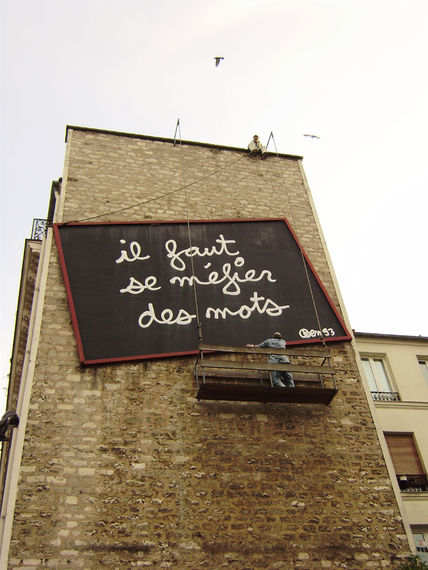
One of my Manchester Literature Festival chums has been busily adding to the Southbank Centre's GPS Global Poetry System project (to which we'll return at a later date), and her latest posting is most interesting to an arty-farty Francophile word lover like myself.


It's about an installation by the artist Ben Vautier, known simply as Ben, who lives in Nice en la belle France. It says "Il faut se mefier des mots", which means "beware of words". Well, I say.

So I've been doing a little wider reading on Monsieur Ben, who seems quite an interesting chap. There's a bit here on his life and work (nice ski goggles, Monsieur. My friend Julian has some suspiciously similar). I've learnt that some of his sculptures are not unlike Jean Tinguely's machines, an exhibition of which is on at Tate Liverpool right now and runs until 10 January: Joyous Machines: Michael Tandy and Jean Tinguely.

(When I first heard about this show, BTW, I got all excited because I thought it had something to do with the director of The Science Of Sleep and Eternal Sunshine Of The Spotless Mind, and, I just learnt, the first episode of The Flight Of The Conchords, although I was just saying yesterday how I'm not really into that, if I'm totally honest. Too much singing. Anyway, I was wrong, obviously. That's Michel Gondry. Obviously.)

So back to Ben, and you see a lot of cartes postales of his phrases on sale in trendy shops in Paris. They always remind me of Magritte's Ceci N'est Pas Une Pipe, from The Treachery Of Images series (La Trahison Des Images 1928–29). Just thought I'd share that.

03 November 2009

Give us a sign

The Times has been running a competition of funny signs over the past few months, entitled (who'd've thought it?) Signs Of The Times. Having selected their favourite 50, it's now up to you to pick your number one. Some are very funny, some are obvious, some are puzzling, and some are thanks to some minxy graffiti artists, so I'm not sure they count. Nonetheless, they're worth checking out over your morning coffee.

31 October 2009

I turned and faced the door...


(This was taken on my way home from the Manchester Blog Awards, hence the slight camera shake, on a dodgy back street somewhere in the Northern Quarter. I quite like graffiti, especially funny stuff like this and arty stuff like you get in Europe. Maybe I'll dig out some more pics and post them, too. We'll see, eh? Don't go getting your hopes up now; I can't promise anything.)